Cyber Security For SMEs?
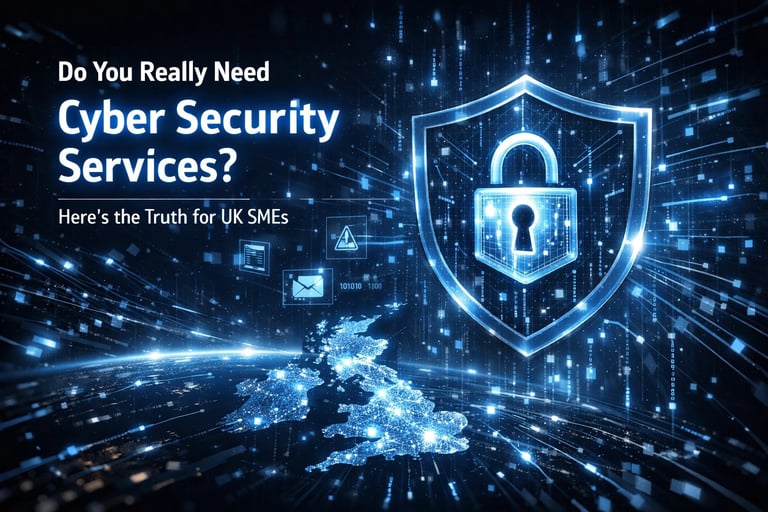
If you are running a small to medium-sized enterprise (SME) in the UK today, you’ve likely asked yourself: “Do I really need to pay for professional cyber security services, or am I just being sold a expensive insurance policy I’ll never use?”
It’s a fair question. For years, the prevailing wisdom for smaller firms was that cyber-attacks were a “big company problem.” You might think that because you aren’t a global bank or a government agency, you aren’t on the radar of international hacking collectives.
But as we sit here in March 2026, the reality on the ground has changed significantly. The truth is that UK SMEs are now the primary target for automated cybercrime. If you have an internet connection, a bank account, or customer data, you are a target.
In this post, we’re going to strip away the jargon and give you the cold, hard facts about the UK threat landscape and why cyber security services are no longer a luxury, they are a fundamental requirement for staying in business.
1. The "Small Target" Fallacy
The most dangerous phrase in modern business is: "We’re too small for anyone to care about."
Hackers in 2026 don’t sit in dark rooms manually typing code to break into your specific office. They use automated "bots" that scan the entire UK IP range looking for known vulnerabilities. They aren't looking for you; they are looking for a door that has been left unlocked.
For a managed service provider, the most common scenario we see is an SME whose systems have been compromised not because of a targeted attack, but because they were simply the easiest fruit to pick. Whether it’s an unpatched server or a staff member using "Password123" for their VPN, these gaps are found by scripts in seconds.
2. Why April 2026 is a Turning Point: Cyber Essentials v3.3
If you operate in the UK, you’ve likely heard of Cyber Essentials. It’s the government-backed scheme designed to protect organisations against the most common cyber threats.
However, the upcoming update, Cyber Essentials v3.3, arriving in April 2026, is a game-changer. The standards are tightening. We are moving into what many in the industry are calling the “MFA or Fail” era.
Multi-Factor Authentication (MFA) is no longer a "nice to have" recommendation; it is becoming a mandatory requirement for almost every access point in your business. If your current IT setup doesn't support robust MFA or passkey technology, you will likely fail your next certification.
Why does this matter?
Insurance: Most UK cyber insurance providers now refuse to pay out, or even offer a policy, if you don't hold a valid Cyber Essentials certificate.
Supply Chains: Larger firms and government bodies are increasingly requiring their SME suppliers to prove their security credentials. No certification means no contracts.
Trust: Customers are more data-conscious than ever. A GDPR breach doesn't just result in fines; it destroys your reputation overnight.
3. The Shift from "IT Support" to "Cyber Security Services"
There is a common misconception that a standard IT support contract is the same thing as a cyber security service. It isn't.
Traditional IT support is reactive. If your printer stops working or your email crashes, you call them, and they fix it. Cyber security services are proactive. It’s about monitoring your network 24/7, hunting for threats before they activate, and ensuring your data storage is encrypted and immutable.
At A500 Tech Solutions, we see the shift every day. Our role as a managed service provider has evolved from being the "fix-it" people to being the digital bodyguards of our clients' businesses.
4. The Real Cost of a Breach in 2026
When we talk about the "truth" for UK SMEs, we have to talk about money. The UK government’s recent data shows that the average cost of a cyber incident for a small business has risen sharply.
It’s not just the "ransom" in a ransomware attack. It’s the:
Operational Downtime: How many days can your business survive without access to its files?
Recovery Costs: Rebuilding a virtualisation environment or restoring thousands of end-points.
Legal Fees: Dealing with the Information Commissioner's Office (ICO) and potential class-action lawsuits from affected customers.
For many SMEs, a significant breach is a "terminal event." They simply never reopen. This is why having a robust Business Continuity Plan (BCP) is vital.
5. How to Secure Your Business: The Action Plan
If you’re feeling overwhelmed, don’t be. Security is a journey, not a destination. You don't have to do everything today, but you do need to start. Here is a brief rundown of where your focus should be:
A. Implement the 3-2-1-1-0 Rule
Modern backup strategies have moved beyond just "having a copy." You should have:
3 copies of your data.
2 different media types.
1 copy off-site.
1 copy offline (air-gapped or immutable).
0 errors after automated backup testing.
B. Adopt Entra Passkeys
Passwords are the weakest link. Moving toward phishing-resistant MFA, like Microsoft Entra Passkeys, significantly reduces the risk of credential theft. It’s faster for your staff and exponentially more secure.
C. Fix Your Patching Strategy
The "Backdoors to Your Network" are often just old software updates that were never installed. A managed service provider can automate this so your hardware and software are always up to date without you having to lift a finger.
D. Network Segregation
Don’t let your guest Wi-Fi sit on the same network as your accounting software. Proper network configuration ensures that if one device is compromised, the "fire" doesn't spread to the rest of the building.
6. Why A500 Tech Solutions?
We understand the unique pressures facing UK SMEs because we live them every day. We don't believe in "one size fits all" security. Instead, we focus on practical, high-impact solutions that protect your bottom line without slowing down your operations.
Our Accreditations & Expertise
As a leading managed service provider, A500 Tech Solutions maintains the highest industry standards. Our team is trained to navigate the complexities of Cyber Essentials Plus and the latest UK compliance frameworks. Whether you are in the financial sector or a local manufacturing firm, we bring enterprise-grade security to the SME market.
We don't just sell software; we provide peace of mind. From cloud migrations to comprehensive cyber protection, our goal is to make your business a "hard target."
7. The Verdict: Do You Need It?
So, do you really need cyber security services?
If you value your data, your reputation, and your ability to trade without interruption, the answer is a resounding yes. The threat landscape of 2026 is too sophisticated for a "DIY" approach to security.
You wouldn't leave your warehouse unlocked overnight and hope for the best. Your digital assets deserve the same level of protection.
How to get started:
Audit: Take a look at your current security posture. When was the last time you tested your backups?
Consult: Speak to an expert. You can learn more about us and how we've helped businesses like yours in our portfolio.
Implement: Start with the basics: MFA and patching: and build from there.
Don't wait for a breach to find out where your weaknesses are. Let’s get your business secured today.
A500 Tech Solutions is a UK registered company. Company Number: 15753263 VAT Number: GB 469 650 352
(C) A500 Tech Solutions 2026